Published 1 July 2026 · Walter Shepherd

Rethinking AI
Reasoning

From Prompts to Governed Thinking

Fluent output is not governed output. The book introduces a practical architecture for scoping claims, registering evidence, testing assumptions, exposing weakest links, assigning reliance and deciding whether an output has earned permission to be used.

TraceableChallengeableAuditableReliance classifiedPermission earned
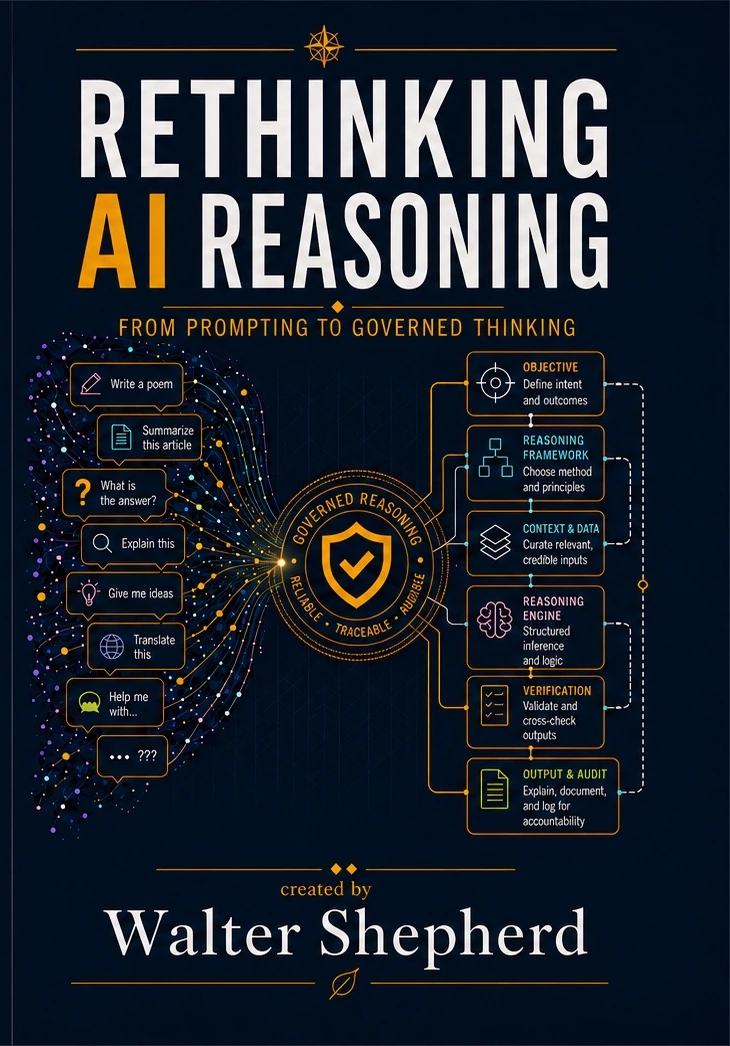
Front cover of Rethinking AI Reasoning by Walter Shepherd
Book propositionAI can already do useful reasoning. What is missing is governance over what that reasoning is allowed to influence.

The single governing question

“What is this claim allowed to do — right now?

A measurement may describe. A correlation may suggest. A forecast may inform. A decision or mandate requires a stronger governance burden. Permission is not inherited from fluent language, model confidence, expert status or consensus. It is earned for the specific claim, source and decision.

Research context

Two bodies of research.
One governance problem.

The book treats recent reasoning-failure research as a map of recurring breakdowns, then asks a different question: what controls should govern the claim before it reaches a decision?

Apple Machine Learning Research2025

The Illusion of Thinking

Apple researchers tested reasoning models in controllable puzzle environments and reported performance patterns that changed with problem complexity. The book uses this work as a reminder that longer or more confident reasoning is not automatically more reliable.

Read the Apple research page ↗
Song, Han & GoodmanTMLR 2026

Large Language Model Reasoning Failures

The survey organises failures across informal, formal and embodied reasoning, including robustness failures. The book maps these failure classes to controls such as scope locking, claim decomposition, stress testing and reliance classification.

Read the paper ↗

Important distinction: the cited papers document and categorise model failures. The mapping from those failures to GovAIaaS / SyncLogic controls is Walter Shepherd’s proposed governance interpretation, not a claim made by the paper authors.

The five governors

Govern the reasoning before
the reasoning governs the decision.

The framework separates claim classification, scope, admissibility, confidence control and drift prevention. Together they create a visible governance layer around AI-assisted reasoning.

1

Fork First

Classify the claim before evaluating it. Measurement, correlation, prediction and decision claims do not earn reliance under the same standard.

2

Scope Lock

Declare who, what, when, where, how and under what conditions the reasoning is permitted to operate.

3

HAT-7

Apply seven admissibility tests to sources, methods, models and tools before they can carry decision weight.

4

SLCD

Detect confidence laundering across summaries, translations, citations, expert claims and hand-offs.

5

Drift Guard

Stage-lock the reasoning chain and prevent silent escalation, substitution or scope migration.

SIP session initialisationClaim decompositionJunction checkpointsExample substitution stress testMulti-model stress testEvidence governanceReliance class declarationPermission to Rely

Beyond prompting. Beyond loops.

A useful progression from generation
to earned reliance.

Prompting can improve expression. Loops can improve consistency. Neither proves that the output is anchored to reality or entitled to influence a consequential decision.

Stage 1

Prompts

Generate useful answers, drafts, summaries and alternatives.

Stage 2

Loops

Repeat, refine and improve a process against a chosen objective.

Stage 3

Evidence

Bring in external standards, registered sources and independent error checks.

Stage 4

Governance

Match the control burden to risk, consequence and intended use.

Stage 5

Reliance classes

State how much reliance the claim has earned and what it may now do.

Precision is not accuracy

A process can produce the same wrong answer repeatedly. Consistency is useful, but it is not external validation.

Accuracy is not entitlement

An answer can be technically correct and still lack the evidence, scope or governance required for a high-consequence decision.

Reliance is claim-specific

The same document may contain low-, moderate- and high-reliance claims. Classification should be claim by claim, source by source.

Agents are the next step

An agent is not yet
a governed agent system.

The book’s perspective distinguishes isolated agents, coordinated workflows and a governed system that can preserve context, register evidence, test outputs and assign permission to rely.

Level 1

Separate agents

Useful specialists, but often disconnected.

  • No shared governance standard
  • Fragmented context and memory
  • Difficult accountability
  • Confident errors can pass between agents
Level 2

Agent teams and workflows

Better coordination and repeatability, but orchestration alone does not establish truth or reliance.

  • Plan, execute, review and deliver
  • Human review points
  • Still needs evidence standards
  • Still needs release authority

The pipe and what flows through it

Workflow capability is valuable.
Claim governance is the next layer.

OpenAI Academy teaches practical progression from prompting to workflows and agents. The SyncLogic perspective does not replace that capability; it proposes additional controls for the evidence and reasoning moving through the workflow.

Build and operate the workflow

Define the job, provide context, set boundaries, review outputs and reuse what works.

Prompts
Workflows
Agents
Human review
OpenAI Academy ↗

Govern the reasoning chain

Ask whether the inputs are admissible, the sources are registered, the hand-offs preserve meaning and the output has earned its reliance level.

Source registration and source-class weighting
HAT-7 admissibility checks
Junction and drift checkpoints
Output reliance classification
Human Permission-to-Rely decision

“OpenAI teaches the pipe. SyncLogic governs what flows through it” is Walter Shepherd’s comparative framing. SyncLogic and GovAIaaS are independent concepts and are not affiliated with or endorsed by OpenAI.

Do not trust the book. Audit it.

The framework should survive
its own standard.

1

Choose a real output

Use an answer from ChatGPT, Claude, Gemini, Grok or another system in a field you understand.

2

Ask for the reasoning record

Request the claims, sources, assumptions, alternatives, uncertainties and weakest links that support the answer.

3

Challenge the output

Ask what evidence would change the answer and what evidence would falsify or narrow it.

4

Compare before and after

Did the answer become narrower, more qualified, better sourced, more transparent or easier to audit? That difference is the framework’s testable value.

There is no going back

AI exists. It is being used.
The remaining question is governance.

Once society knows that AI can analyse, compare, critique, generate alternatives and assist decisions, simply pretending it can be removed from the world is not a serious operating plan.

Trust AI blindly

Fast, attractive and dangerous. Capability is mistaken for entitlement and fluent answers are allowed to carry undeclared decision weight.

Reject AI blindly

Sometimes justified for a task, but as a universal response it discards useful capability and avoids the harder work of setting conditions for use.

Learn to govern AI

Define boundaries, register evidence, challenge assumptions, assign reliance and keep human authority over permission to rely.

The most important discovery of the AI era may not be that machines can think. It may be that reasoning can be audited, challenged and governed at scale.

Front cover of Rethinking AI Reasoning by Walter Shepherd

The book

Rethinking AI Reasoning

From Prompts to Governed Thinking

Artificial intelligence can produce fluent answers in seconds. In research, policy, law, regulation, quality, risk and decision support, fluency is not enough. This book presents a practical framework for moving from pattern-completion theatre to reasoning that can be scoped, traced, tested and released at a declared standard.

Why prompting alone is not enough for serious work
How scope, sources, verification and audit fit together
How to challenge assumptions and competing explanations
Why reliance boundaries and permission matter
Buy Rethinking AI Reasoning ↗

Print ISBN 978-1-7641887-2-2 · eBook ISBN 978-1-7641887-3-9 · Published 1 July 2026
Companion application

Rethinking the Causes of Climate Change

The climate book applies structured AI-assisted reasoning to a contested evidence domain. It uses three thinking hats—IPCC, sceptical and physics-first—to compare claims, mechanisms, assumptions and real-world observations.

Rethinking the Causes of Climate Change companion book infographic

About the author

Walter Shepherd

Walter Shepherd is the founder of SyncLogic Systems and the creator of the GovAIaaS governed-reasoning framework. His background includes clinical laboratory science, regulatory affairs and ISO quality-system auditing across ISO 9001, ISO 15189 and ISO 13485 environments.

The framework draws on a laboratory distinction that is easy to lose in AI work: a method may be precise without being accurate, and an accurate result may still lack the evidence or governance needed for a particular decision.

Sources and status

Research links and boundaries.